399 Rifles Handover at TinCan Command, CGC Adeniyi like a Person in Ordnance Factory

399 Rifles Handover at TinCan Command, CGC Adeniyi like a Person in Ordnance Factory
...Supports government efforts to stem the tide of insecurity

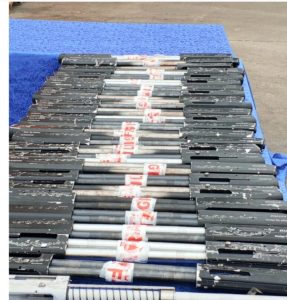
The Enforcement Unit of TinCan Island Customs Command on Monday, 17 August 2026, assumed the eerie appearance of an Ordnance Factory, as the Comptroller General of Customs, CGC Bashir Adewale Adeniyi, MFR, PhD, formally handed over 399 fully assembled UJF pump-action rifles and 535 assorted firearm components to National Centre for the Control of Small Arms and Light Weapons ,NCCSALW.
The imposing display of weapons, laid out following meticulous examination and documentation, offered a sobering reminder of the grave security consequences that could have unfolded, had the deadly consignment slipped through Nigeria’s ports undetected.
What initially looked like an Armoury was, in reality, a compelling demonstration of Customs’ enforcement ingenuity, intelligence capability and institutional vigilance. The weapons had been deliberately dismantled and concealed in knock-down form in an apparent attempt to circumvent detection and defeat established cargo-control mechanisms.
However, the consignment encountered the alertness of Comptroller Joe Anani and his officers, whose intelligence-led intervention ensured that the dangerous cache did not proceed beyond the port.
The interception represents a significant operational triumph and a powerful testament to the professionalism of officers entrusted with protecting Nigeria’s territorial and economic frontiers.

As CGC Adeniyi disclosed, the offensive consignment arrived at TinCan Island Port on 8 July 2026, aboard MV Velika and was subjected to examination after being flagged by the Nigeria Customs Service risk-management system.


Depth of Technical Competence :
What followed was a painstaking process of examination, inventory, and documentation that ultimately exposed the true nature of the cargo. The completed inventory revealed 399 fully assembled UJF pump-action rifles and 535 firearm components, including 89 frames, 80 charging handles, 579 trigger groups and 25 locking lugs.
The precision with which the officers identified, assembled and documented the various components underscores the depth of technical competence and operational alertness deployed by the Service.
Consequential National Security Narrative :
Beyond the impressive statistics of the seizure lies a far more consequential national-security narrative. Had such a formidable arsenal reached the wrong hands, the weapons could have been diverted into the networks of terrorists, bandits, kidnappers and other criminal elements, potentially aggravating the cycle of violence and insecurity confronting the nation.
At a time when illicit firearms remain a potent enabler of violent crime, the interception effectively removed a substantial quantity of lethal instruments from circulation and, in the process, potentially saved countless lives and communities from the devastating consequences of their misuse.
Strategic Leadership of CGC Adeniyi :
The seizure also demonstrates the strategic leadership of CGC Adeniyi in repositioning Customs beyond its traditional revenue collection mandate towards a more comprehensive national security role.
Under his leadership, technology, intelligence and risk management have increasingly become central pillars of Customs operations. The deployment of automated risk-management systems, cargo tracking, modern clearance processes and non-intrusive inspection capabilities has strengthened the Service’s capacity to identify high-risk consignments without subjecting every container to physical examination.
As the CGC aptly underscored, the essence of technology is to enable Customs know which container to open, a capability that can make the difference between an ordinary cargo examination and the interception of a potentially catastrophic security threat.

Arrest of Suspects :
Significantly, the success was not confined to the seizure itself. Two suspects linked to the attempted importation, Robert Eze and Ejeogu Gosen, were arrested and placed before the Court. One of the suspects was reportedly arrested on 31 July at Ibonde Terminal while allegedly attempting to facilitate the release of the container. Their remand by the Federal High Court in Lagos, with arraignment scheduled for 25 August, further demonstrates the determination of the Service to pursue enforcement beyond the point of interception and ensure that those behind illicit importation are brought within the ambit of the law.

Seizure of Illicit Drugs :
TinCan Command also recorded another major interception involving cannabis infused products concealed among imported goods in two 40-foot containers, with a street value estimated at N373.8 million.
Inter-Agency Collaboration :
The illicit drugs were subsequently handed over to National Drug Law Enforcement Agency ,NDLEA, showing the importance of inter-agency cooperation in confronting transnational criminal networks.
More so, the CGC’s scheduled engagement with the NDLEA Chairman at Navy Town, Ojo, Lagos, for a programme involving the destruction of seized narcotic substances further reflects the institutional synergy required to ensure that prohibited commodities intercepted by security agencies do not find their way back into circulation.
The TinCan seizures, therefore, stand as more than an impressive enforcement statistic; they constitute a resounding affirmation of Customs’ vigilance, intelligence architecture and patriotic commitment to national security. By preventing hundreds of deadly firearms from reaching their intended destination, CGC Adeniyi and the officers under Comptroller Anani have reinforced the government’s broader efforts to stem the tide of insecurity and protect Nigerians from the consequences of illicit arms proliferation.
The handover, received on behalf of the NCCSALW by retired Deputy Inspector General of Police Johnson Babatunde, aptly symbolises a shared national responsibility, which Customs’ vigilance at the point of entry becomes an indispensable bulwark against threats to lives, communities, democratic processes and the stability of the nation.